03: The Health Scare that Became My Origin Story
On cancer as a catalyst
Before 2018, I had no idea what holistic health and wellness was.
I grew up in a relatively health-conscious household. My parents were especially strict around sugar and “junk food.” We could have soda as a treat when we went out to dinner, and each kid got to pick out a special box of sugary cereal—just for us, no sharing with siblings required—on our birthday (I always went with Cinnamon Toast Crunch).
Otherwise, it was a lot of Kashi cardboard—ope, I mean…cereal—and 100-calorie snack packs 🥲
Did that leave me wanting as a kid, and did I scarf down plenty of Cheetos, Gushers and M&M cookies at my friends’ houses during play dates? You bet.
Am I grateful now that my parents helped me learn the importance of limiting refined sugar in my diet early on? You bet!
All that to say, lack of junk food aside, I grew up with a pretty standard understanding of what it meant to be “healthy.”
That being: health was an externalized trait.
“Healthy” meant your body looked and behaved a specific way. It was mostly about how you were perceived by others, if we’re being honest.
And diet and exercise were the tools to achieve this. You did some cardio, made sure to eat a few fruits and vegetables, and called it a day. You only went to the doctor when you were sick and, if it was bad enough, you got a prescription (likely an antibiotic or painkiller) to help take care of whatever it was. I thought that was the whole story 🤷🏻♀️
This approach is an example of what is commonly referred to as conventional or allopathic medicine.
It focuses on treating specific symptoms and conditions—often viewed as if they exist in a vacuum—and frequently relies on pharmaceuticals as a frontline response. The primary aim is eliminating symptoms, though oftentimes merely silencing or suppressing them is considered getting the job done. Out of sight, out of mind.
While there is certainly a valid place for this in a comprehensive care approach, especially in acute and crisis response situations, it falls short when it comes to long-term, root-cause healing and wellbeing.
And what I didn’t understand at the time was how fragile this definition of “health” actually was—or how quickly it could unravel.

I took my first yoga class my freshman year of college for a required PE credit. I liked it enough to keep seeking out classes after that semester, but I was still firmly rooted in the mindset that “healthy = diet + exercise.”
So while I showed up on the mat, I didn’t really connect with the meditation, breathwork, or spiritual elements of the practice.
I truly didn’t know what I was missing…yet.
It wasn’t until early 2018 that everything changed. One day—in a yoga class, actually—I felt a lump on the back of my shoulder blade. Multiple doctor’s appointments, X-rays and a 2-hour MRI later and…it was bone cancer.
Never did I ever think I would get cancer in my 20s.
My world temporarily crumbled. How could this be happening? I was supposed to be healthy.
That diagnosis lit up something in me that’s been burning ever since—a deep, relentless drive to understand health and wellbeing, beyond social perception and an outdated USDA food pyramid. I wanted to get to the root of what it truly means to be healthy.
And the more I learned, the more that drive expanded until it wasn’t just personal, but something I felt called to share with others. Because this kind of wisdom isn’t meant to be gatekept—it’s meant to be lived and embodied on a collective level.
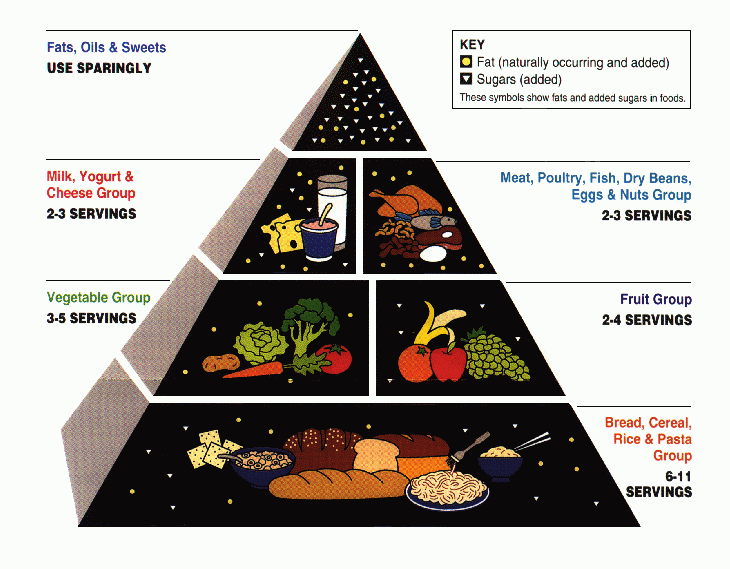
Remember her?! RIP to all those carbs after 2005 (image from Wikipedia)
Holistic health and wellness, in contrast, is a multi-faceted approach that considers every aspect of Self—body, mind, spirit—and understands wellbeing as something supported by many interdependent pillars.
It’s not just diet and exercise that shape us. It’s our sleep hygiene, stress levels, mental health, social connections and sense of meaning or spiritual fulfillment, too.
It takes into account our nervous system, gut microbiome and fluctuating hormone levels as well as mindfulness practices, capacity for emotional processing, spending time in nature and minimizing exposure to harmful substances.
The most important thread woven through all of this, I learned, was the realization that the conventional model of health is missing many key pieces of the puzzle, and often frames us as victims of our own circumstances.
The truth I was uncovering? That we have far more influence over our health and wellbeing than we’ve been led to believe.
We don’t have to simply accept the fate of our genetics and family history. Yes, these factors matter—but our present-day environment, behaviors, beliefs and daily choices speak much louder.
This is beautifully illustrated through the exposome and epigenetics—the study of how our environment and lived experiences influence our gene expression. So while our DNA provides the blueprint, many genes can be switched “on” or “off” based on how we interact with the world around us.
In other words, the ways we sleep, eat, think, connect and cope isn’t just “self-care”—it’s an active form of communication with our bodies.
More on that fascinating topic another time!
Often referred to as holistic or integrative healthcare, this approach focuses on the whole person, with a goal to address the underlying root cause of symptoms and conditions—all while recognizing that nothing exists in a vacuum.
And rather than defaulting immediately to pharmaceutical or surgical interventions, it prioritizes lifestyle shifts, nervous system support and, when appropriate, natural herbs and supplements—while still honoring the role of allopathic medicine when it’s truly needed.
It also draws on ancient wisdom and practices developed over thousands of years, many of which originate from Asian cultures—hence the common distinction between “Eastern” and “Western” medicine.
Another key difference? A strong emphasis on preventative care and full-spectrum wellness, rather than simply aiming for a net-neutral baseline of “not sick.”
Sound like a lot? It can be! I was definitely overwhelmed when I opened this Pandora’s box back in 2018. The more I researched and rabbit-holed, the more I realized I had yet to learn.
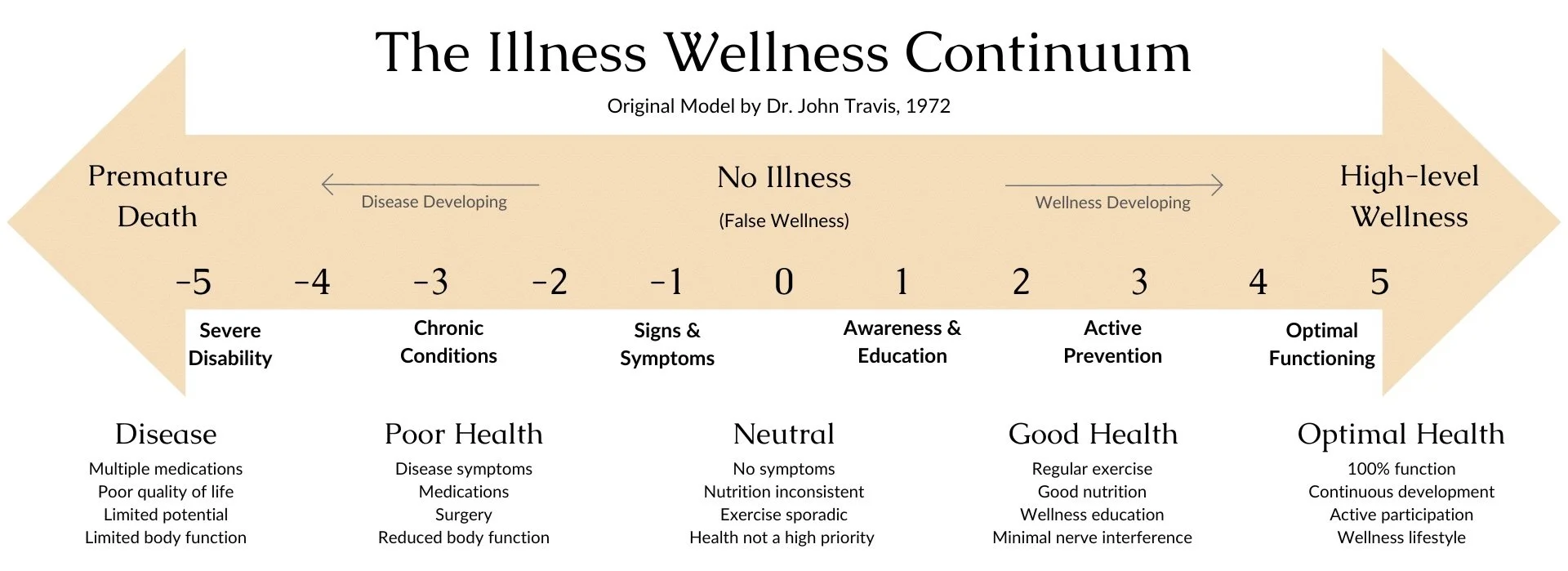
The Travis Illness Wellness Continuum (image from Lore of Life)
And for the record—thankfully, I had a successful surgery and remain cancer-free today. And that’s on modern medicine! This approach isn’t the villain (that’s cancer, duh)—it just has real limitations.
Today, I bring more than seven years of continued education, ongoing research and lived experience so that you don’t have to start from scratch the way I did.
In my years as a coach, I’ve helped hundreds of people work toward goals they once thought were out of reach—and now, Sacred Vessels here to help you do the same.
Rather than watch you throw a whole plate of spaghetti at the wall to see what sticks, I can help you save time and…find…the stickiest strands? You know what I mean.
I’m here to help you identify the most meaningful starting points in your life—pinpointing which changes will have the broadest impact and how to build a strong, sustainable foundation for long-term health and wellbeing.
Because everyone’s nervous system, history and capacity are different. And everyone deserves a personalized approach to honor that.
Sacred Vessels is here as a companion in this process.
A steady guide.
An earnest co-pilot.
A lantern when things feel murky.
A trusty map you can return to—again and again—on the long, winding road back home to yourself.
And FYI, this isn’t about optimizing your life or “fixing” yourself—it’s about unlearning what never served you and building a life that does, on your own terms.
You don’t need to do everything at once. You don’t need to do it perfectly. You just need a place to begin.
How about here? 📍
Interested in learning more
about how personalized coaching can help you build the life of your dreams? Book a free curiosity call!
About the Author
Kaitlyn Carroll (she/her) is a National Board Certified Health and Wellness Coach and the founder of Sacred Vessels. She writes at the intersections of of science, spirituality and self-inquiry with radical honesty, curiosity and compassion.
This is the third essay in a 5-part manifesto series. Read the rest here: